
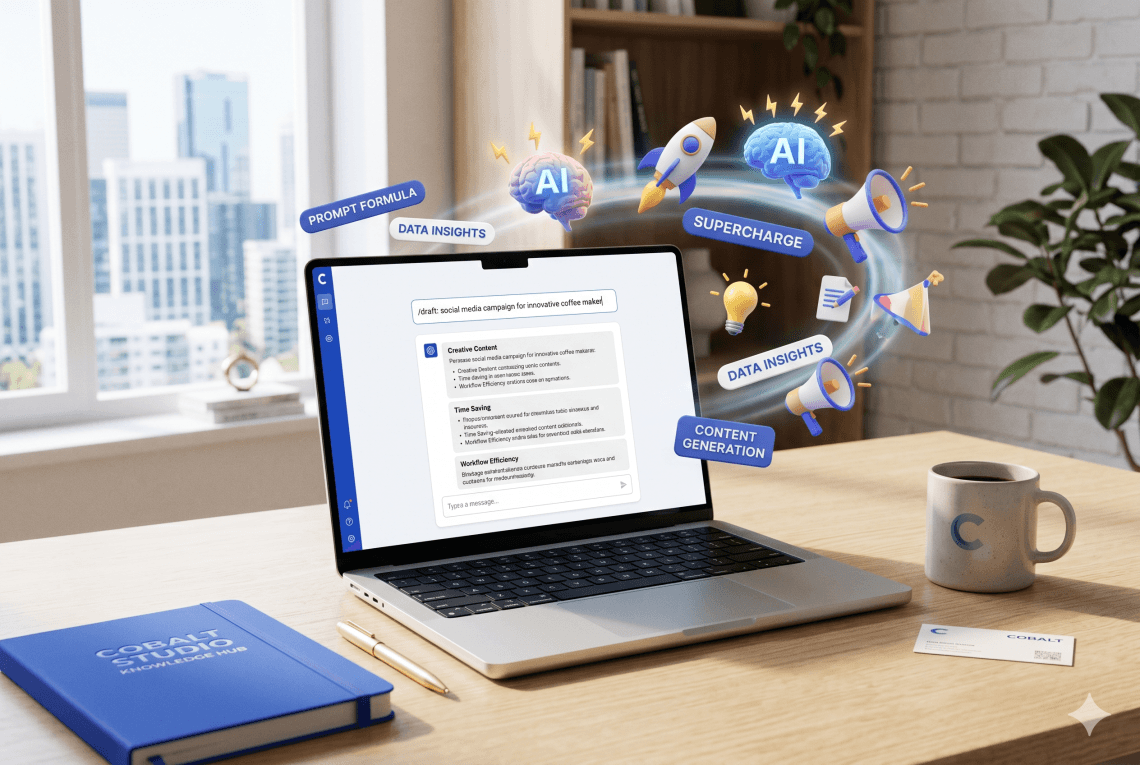
Generative AI: Supercharge Your Workflow
Artificial Intelligence is no longer just a futuristic concept. Today, text-based generative AI operates as a powerful writing assistant that can help small businesses optimize their operations, enhance content creation, and save massive amounts of time.
Understanding how to effectively leverage these tools is crucial for staying competitive. Here is a foundational guide to understanding generative AI and mastering the art of prompting.
AI vs. Automation vs. Search Engines
To maximize the value of AI, it helps to distinguish it from other common digital tools:
- AI vs. Automation: AI acts as the brain because it can analyze information and make choices based on what it learns. Automation acts as the muscle because it simply follows pre-programmed instructions to complete repetitive tasks.
- AI vs. Search Engines: Browser search operates like a library catalog that matches keywords to web pages, leaving you to do the actual research. AI search functions like a research assistant by understanding your specific intent and context to synthesize direct, tailored answers.
Key Benefits for Small Businesses and Marketers
Integrating generative AI tools like ChatGPT, Google Gemini, or Microsoft Copilot into your daily routine offers distinct professional advantages:
- Enhanced Content Creation: Generates high-quality drafts for blog posts, website copy, and social media ads efficiently.
- Substantial Time Savings: Helps get creative ideas off the ground quickly and allows you to reiterate existing copy much more effectively.
- Operational Efficiency: Handles repetitive tasks, assists with rapid prototyping, and automatically generates documentation.
- Data-Driven Insights: Provides clear summaries of dense text and analyzes market trends to aid strategic decision-making.
Core Principles of Effective Prompting
The quality of an AI model’s response depends directly on the clarity and specificity of your input prompt. Keep these three basic rules in mind when interacting with AI:
- Be Specific: Provide as many explicit criteria as possible to ensure a highly focused output.
- Work in Steps: Break large or complex tasks into smaller, manageable chunks rather than asking for everything at once.
- Iterate and Improve: Do not hesitate to re-work your inputs and explicitly ask the AI to criticize or refine its own previous output.
The Ultimate Prompt Formula
When you need high-quality content, do not rely on simple, single-sentence questions. Instead, construct your prompt using this structured five-part framework:
- Role: Define the specific persona or expert identity you want the AI to adopt.
- Result: Specify the exact type of text format or asset you want generated.
- Goal: Explain the ultimate purpose or business objective behind the content.
- Context: Provide crucial background details regarding who, what, where, or why.
- Constraint: Outline explicit limitations, such as word counts, specific keywords, or tone rules.
A Practical Example to Try:
“You are an expert marketing strategist. Create a compelling social media campaign. The goal is to increase brand awareness and drive website traffic. The content is for a new eco-friendly product launch. Your guidelines for writing are to keep it concise, use strong visuals, and target a sustainable-conscious audience.”
Advanced Techniques to Maximize Efficiency
Once you are comfortable with basic prompts, you can implement advanced frameworks to handle more complex business scenarios:
- Tabular Format Prompting: Request that the AI break down its answers into separated columns within a single table for cleaner organization and easier data analysis.
- Ask Before Answer Framework: Explicitly instruct the AI to ask you clarifying bullet point questions about your task before it attempts to generate a final answer.
- Perspective Prompting: Broaden your understanding of a topic by asking the AI to write an argument from singular or multiple diverse viewpoints.
- Constructive Critic Framework: Have the AI act as an industry expert to evaluate your existing text drafts step by step, explicitly telling you why it might perform poorly and offering exact feedback for improvement.
By mastering these simple frameworks, you can transform AI from a basic chatbot into a highly capable digital assistant that handles heavy lifting for your business operations.
Download the Full Presentation
Ready to dive deeper and explore visual prompt techniques, step-by-step frameworks, and tools to completely transform your creative workflow? Get your own copy of the entire slide deck directly from Cobalt Studio: